
From Cost Center to Profit Center: How Corporate Data Becomes the Next AWS-Scale Opportunity
Turning Corporate data from a liability into an asset with ai.market
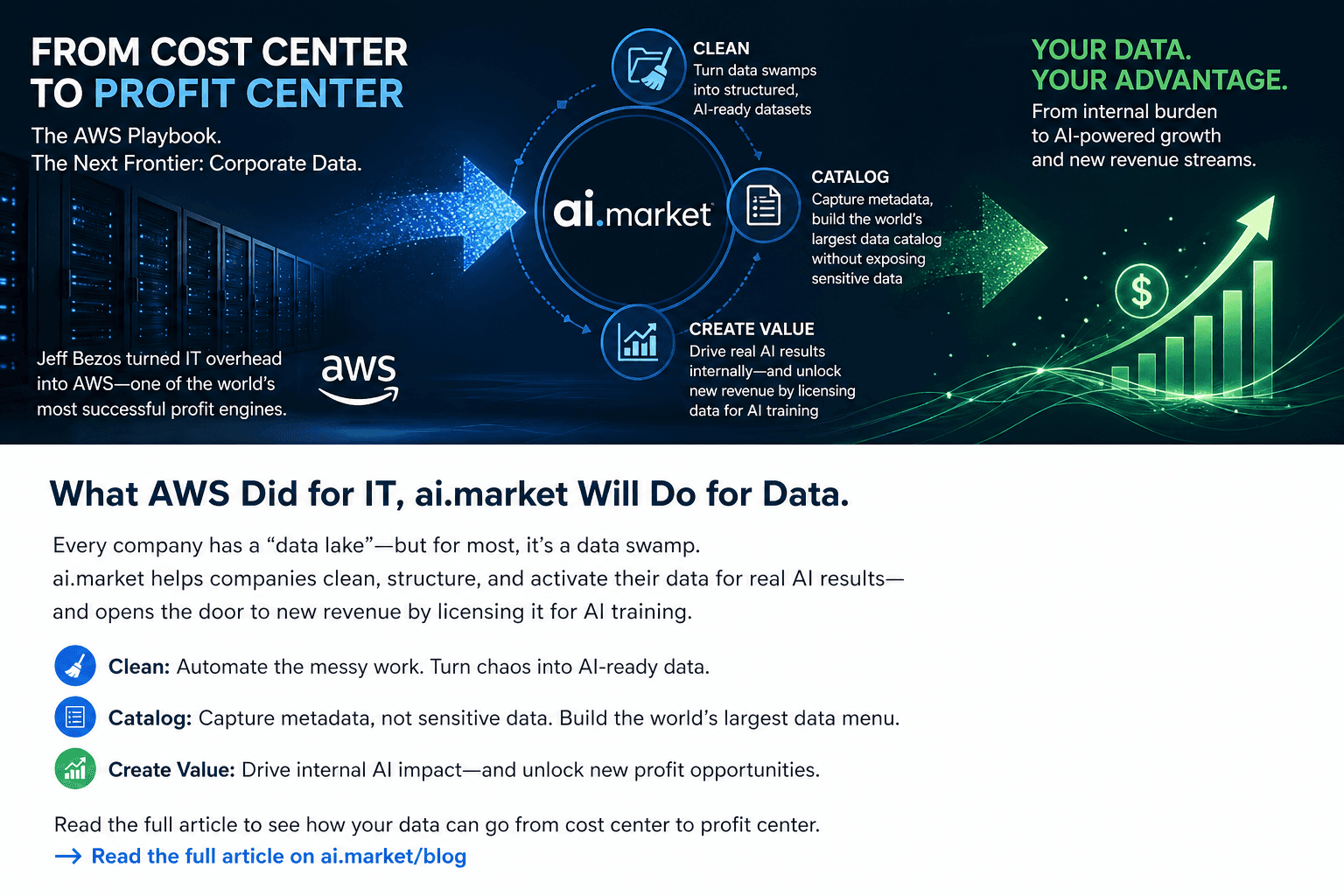
Turning Corporate Data Swamps Into AI Assets
When Bezos pushed Amazon to standardize and externalize its internal tech infrastructure, he ended up creating one of the most important business shifts of the modern era. Servers, storage, compute, developer tools, all the stuff Amazon had to build for itself, became AWS. The overhead of Amazon's IT department turned into a global profit engine.
The same pattern is now showing up around corporate data.
For decades, companies have treated data as a byproduct of doing business. Sales teams generate CRM records. Operations teams produce logs. Finance creates spreadsheets. Customer service captures conversations. Product teams collect usage patterns. Supply chains generate vendor, inventory, pricing, and fulfillment data.
The result is that almost every company sits on a huge internal data lake. In reality most of these lakes are closer to swamps. Messy, fragmented piles of CSVs, JSON files, logs, Excel sheets, PDFs, and database exports that very few people can easily query or apply.
That is the opportunity ai.market is built around.
The Hidden Overhead Inside Corporate Data
Companies have spent a lot of money collecting data, storing data, and hiring people to analyze data. The uncomfortable truth is that most of it is not immediately usable.
Data scientists and analysts spend most of their time cleaning, labeling, normalizing, and structuring data before they can do anything useful with it. Too much time is spent preparing data, and too little time is spent actually using it.
That preparation work has always been treated as overhead. It is necessary, expensive, repetitive, and almost never seen as a revenue opportunity in itself.
This is how IT infrastructure used to be viewed too. Servers, storage, networking, all the things needed to run a business but not seen as standalone products. Amazon changed the logic. It took something it had to build for itself, standardized it, and made it available to everyone else.
ai.market applies the same logic to data.
The question is no longer "how do we manage all this internal data?" The better question is "how do we turn this data burden into something that creates real AI value, and possibly new revenue?"
Before Companies Can Sell Data, They Need to Understand What They Have
A lot of people think the data economy starts with companies selling datasets. That skips the most important step.
Most companies are not ready to sell data because they don't actually know what they have. They don't know where it lives, how clean it is, what rights are attached to it, or whether it's useful for AI in the first place.
This is where ai.market starts.
We are not trying to build a marketplace where companies throw raw data over the wall and hope someone buys it. The real starting point is helping companies clean, organize, and understand their own data first.
That means turning chaotic internal files and fragmented systems into structured, searchable, AI-ready assets. It means helping a company go from "we have years of data somewhere" to "we know exactly what we have, what condition it's in, and how it can be used."
This is the foundation for real AI results. AI does not create value just because data exists. AI creates value when the right data is clean, structured, permissioned, and accessible for the right use case.
The Metadata Advantage
The most powerful part of this model is that ai.market does not need to possess a company's sensitive data. The smarter move is the opposite.
ai.market helps companies clean and organize their own data while capturing metadata, the description of what exists, not the sensitive contents themselves.
That metadata becomes the menu of corporate data.
It can describe categories, formats, volumes, industries, update frequency, quality, structure, and possible use cases without exposing customer records, trade secrets, or regulated information.
This distinction matters a lot. Companies are reasonably cautious about sharing raw data. They are much more open to sharing information about what kind of data they have, especially if doing so helps them improve internal AI performance, governance, and monetization readiness.
In exchange for helping companies clean their data swamp, ai.market gets to build one of the most valuable catalogs of corporate data assets out there.
That catalog becomes the foundation of a future marketplace. Not a reckless exchange of raw information, but a structured, permissioned, commercially useful intelligence layer that helps buyers, AI companies, model builders, and enterprises understand what data exists and how it can be licensed or applied.
Turning Internal Data Into Real AI Results
The first value to companies is not theoretical resale. It is internal performance.
Companies want AI results. Better forecasting, faster customer insights, automated workflows, smarter sales operations, better risk models, more efficient decision-making. Most companies cannot get there because their data is too messy.
ai.market closes the gap between owning data and being able to actually use it.
A company often already has the raw material to power valuable AI systems. What it lacks is the layer that cleans, maps, labels, and prepares that data so it can be used.
Once that layer exists, the company can start turning its internal data from a cost center into a productivity center. And in some cases, into a profit center.
That progression matters. First, data becomes usable. Second, data produces internal AI outcomes. Third, data becomes an asset that can be licensed, benchmarked, packaged, or sold for AI training and specialized model development.
This is the same business shift AWS pulled off. Take something the company already had to build, standardize it, make it scalable, and turn it into a market-facing asset.
The Next Great Enterprise Asset Class
For years, people have called corporate data "the new oil." The comparison is incomplete. Oil is only valuable after it is extracted, refined, transported, and distributed. Raw data works the same way.
Unrefined corporate data is mostly expensive clutter. Refined, structured, permissioned, AI-ready data is an asset.
The companies that understand this distinction will have an edge in the next phase of AI. Not only will they use AI more effectively internally, they will be in a much better spot to participate in the growing market for high-quality training data.
AI models are only as good as the data used to train, fine-tune, and evaluate them. As the AI market matures, generic internet-scale data is not going to cut it. The most valuable AI systems will need specialized, domain-specific, high-quality data from real business environments.
That means corporate data, properly cleaned, described, governed, and permissioned, may become one of the most important asset classes of the AI economy.
ai.market's Position
ai.market sits at the intersection of three real needs.
Companies need to clean and activate their own data. AI builders need better training and evaluation data. The market needs a trusted catalog that can connect data supply with AI demand without compromising sensitive information.
By starting with the cleaning layer, ai.market solves an immediate pain point. By capturing metadata, we build a strategic catalog. By enabling future licensing and monetization, we give companies a path to turn dormant data into revenue.
This is not just a marketplace play. It is an infrastructure play.
AWS did not win because Amazon happened to have extra servers. It won because Amazon turned internal infrastructure into a standardized, scalable platform that other companies could use.
ai.market has the chance to do the same thing with corporate data. Not by asking companies to give up control of their information, but by helping them understand it, structure it, activate it, and eventually monetize it.
The Bigger Picture
The next wave of AI will not be won only by the companies with the biggest models. It will be won by the companies with access to the best data.
That is a real opportunity for enterprises that have spent years piling up information without ever turning it into strategic value.
The data swamp can become a data asset. The cost center can become a profit center. The internal burden can become an external opportunity.
That is the shift ai.market is built to lead. Helping companies turn the data they already have into real AI results, and eventually into a new source of enterprise value.